
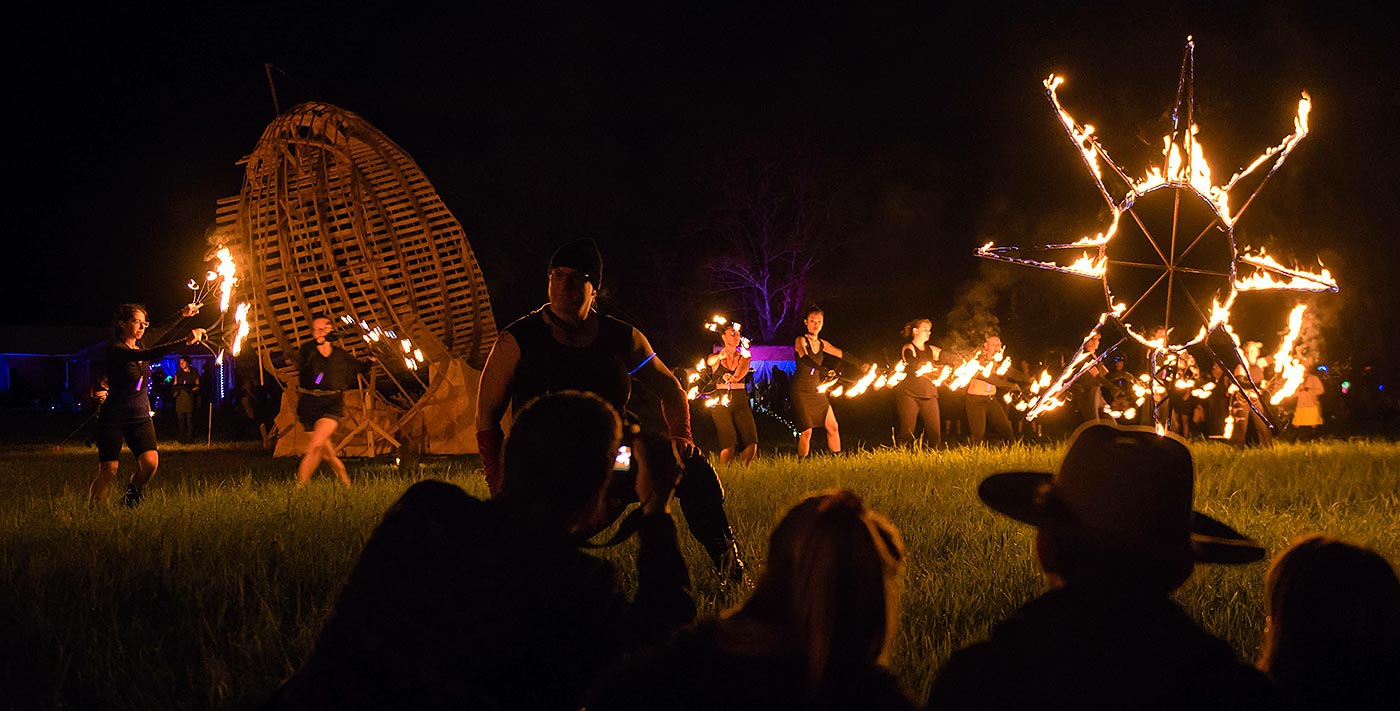
Being at a burn, we accept all sorts of fire-based activities. All flame effects must undergo inspection by FAST and be supervised by trained operators. Guidelines from NFPA 58 and NFPA 160 are followed for proper design, particularly for tanks and pressure vessels, plumbing systems, control systems, and general safety measures. The guidelines emphasize the importance of secure storage, proper tank conditions, and the use of appropriate materials for plumbing and connections. Additionally, specific requirements for control systems, pilot systems, and site placement are outlined to ensure the safe operation of propane flame effects, with a strong emphasis on fire safety, clear areas, and operator sobriety.
The use of propane flame effects at SideBurn involves two main categories:
- Static Effects: Gentle flames in a controlled setting like tables or fire pits.
- Dynamic Effects: Characterized by larger bursts in a “poofer” style.
Flame Effects are devices that use pressurized LP (Liquefied Petroleum, AKA Propane) gas to make visible fire, either in the form of gentle flames in a table or fire pit (AKA Static Effects), or big bursts in a “poofer” style effect (AKA Dynamic Effects). Propane flame effects are prohibited during a Stage 2 burn ban, but may be allowable during a Stage 1 burn ban, at the discretion of SideBurn and the Fire Art team.
- All flame effects must pass inspection before being operated at SideBurn.
- All flame effects must be directly attended to and supervised by an appropriate number of trained operators at all times.
- Please have a plan for safe storage of any refill fuels that are not in use.
Sculpture Guidelines
SideBurn uses NFPA 58 “Liquefied Petroleum Gas Code” and NFPA 160 “Standard for Use of Flame Effects Before an Audience” as guidelines for proper design of flame effects.
Tanks and Pressure Vessels
- Tanks and accumulators must be in good condition, have a valid certification stamp no more than 10 years old, and be rated for the pressures they will be exposed to.
- Tanks and accumulators should be free of rust (especially the bottom).
- Welding or modifications to tanks or pressure vessels is not allowed (unless such welds are completed by a certified welder qualified to repair LP tanks).
- Tanks should not be placed in an environment where they will be exposed to extreme heat or extreme cold.
- Tanks should be secured to prevent tip-overs. Do not modify or remove valve-guards.
- Tank connectors must be listed for use with LP gas.
- All tanks, lines, and sculptural components must pass a leak test during inspection.
- Tanks must be at least 10’ from any ignition source. This means that hoses will need to be at least 15 feet long to run along the ground safely and not pose a tripping hazard
Plumbing Systems
- 1⁄4-turn ball valves must be provided for rapid shut-off. At a minimum these valves must be placed at the tank, near the effect head, at the accumulator, and at the pilot light.
- Fittings and hoses must be fully rated for the pressures they will be exposed to.
- Hard pipe and fittings must be black pipe, not galvanised
Note: Because unregulated LP tanks can reach over 300psi at high ambient temperatures, this means that standard Schedule 40 steel pipe connectors are not sufficient for connections on the supply-side of your regulator! Schedule 80 steel or high-pressure brass or copper fittings are required on the supply-side of regulators.
- Pressurized systems must have pressure-rated fittings and pipes. Copper, steel, and reinforced flexible LP gas lines are acceptable. PVC or vinyl tubes are not.
- Pipe and hoses in the pressurized system must not have any welds or modifications. Pipes and hoses in the egress system may have modifications since they are not expected to hold pressure.
- Connections in copper flexible lines must use flare fittings, not compression.
- Copper flexible lines must be types K, L or ACR for use with LP gas.
- Flexible hose assemblies must have a CSA or equivalent tag and be rated for use with LP gas and the pressures they are exposed to (usually 350 psi max
- Teflon tape or pipe dope should be listed for use with LP gas (yellow color). All NPT fittings should be taped or doped, but flare fittings must be installed clean.
- Quick Connect fittings must be designed for LP gas, and be of the DESO “Double End Shut-Off” style to hold back pressure on both sides – air-compressor fittings are not generally acceptable because they will release pressure on one side of the fitting when disconnected, potentially venting propane from tanks or accumulators in an unsafe manner.
Control Systems
- Controls should always be “fail safe”, i.e., an electrical fault or loss of power should result in the system shutting down, NOT opening up. Generally this means NO (normally open) solenoid valves are not acceptable unless there is a backup automatic shutoff.
- Publicly controllable installations are acceptable, but the individual responsible for the art must be present and supervising.
- Control systems should be lockable to disable them while not in use. Key-locks, removal of a proprietary battery or control panel are all possible methods.
General Guidelines
- Pilot systems should be reliable and easy to light.
- Wind protection for the pilot is highly recommended.
- If manual re-lighting is necessary, shut down all gas flow and wait 60 seconds before attempting to re-light.
- Effect head (point of discharge) must be at least 10′ above ground, or you must stake a suitable perimeter around your effect. Effect head should always point up, unless a suitable large perimeter is set (and staffed) during operation.
- Valve seals must be made of propane-compatible materials, ie FKM (Viton) or nitrile (Buna-N, NBR)
- Bring a printed copy of your site plan, safety plan, and system diagram.
Site Guidelines
- Clear combustible material around your effect to a minimum of 10’ radius. Larger effects may require a larger clear area.
- Place the effect away from trees, tents, structures and overhanging branches. Remember that your poof may emit at a 90 degree angle during windy conditions!
- You must provide ABC extinguishers suitable for your installation. These must be placed away from the main flame effect, but in clear sight of the public (a stranger may be the one to save you!).
- Fuel storage areas must be clearly marked, to include no-smoking signs, and red beacon/light/glowstick for night time.
- Portable effects are allowed as long as clear areas are chosen for operation, the effects are aimed safely (straight up), and clear over people’s heads and surrounding structures.
- Operators must be sober!
If you have any questions, please reach out to fast@sideburn.ca.
Related resources
Fire
For more details on our fire safety policies and guidelines, please review the full Fire Policy page.
Fire Pits and Burn Barrels
For detailed information on the regulations and safety guidelines for fire pits and burn barrels, please review the full Fire Pits and Burn Barrels Policy page.
FAST-Required Documentation
Learn how to create a Burn Plan and review the FAST-required documentation for planned art burns in our comprehensive guide.